
Ranked 7th by Newsweek’s World’s Best Hospitals 2026 list, Sheba is integrating AI into active care settings, adapting systems to the needs of different departments, and evaluating how they perform in everyday clinical work. This approach supports the medical center’s broader vision of a fully AI-powered hospital grounded in clinical needs, responsible implementation, and clear governance.
Beyond the Emergency Department
One of the clearest examples is SmartER, Sheba’s ambient AI platform, originally developed to address the significant documentation burden facing physicians in the emergency department.
After its launch, demand for the platform grew across the medical center. SmartER was then tailored to the workflows of internal medicine and outpatient clinics, allowing a system first designed for emergency care to support a wider range of clinical settings.
SmartER also supports conversations in Hebrew, English, Arabic, and Russian, helping physicians communicate with Sheba’s diverse patient population while maintaining consistent medical documentation.
Implementation, Evaluation, and Adaptation
For Sheba, deploying an AI system is only part of the process. What happens once clinicians begin using it is equally important.
SmartER produced an unexpected finding: reducing the documentation burden in the emergency department did not reduce patient waiting times. Instead, physician and patient experience improved. The results suggest that the time saved on typing was redirected to the clinical encounter itself, allowing patients to ask more questions, physicians to gather more information, and documentation to become more comprehensive.
The experience has helped shape how Sheba evaluates AI in practice. Rather than focusing on a single measure, teams assess factors including documentation quality, physician and patient experience, administrative workload, adoption across departments, and daily physician use.
Together, these measures provide a fuller picture of whether an AI system is creating real value once it becomes part of everyday care.

Innovative Solutions Built on Clinical Insight
Supporting this approach is the AI Center at ARC, Sheba’s global healthcare transformation and innovation ecosystem.
The Center brings together technology professionals and clinicians, with some physicians working part-time as product managers alongside engineering teams. This helps ensure that development begins with real clinical problems and focuses on where AI can provide meaningful support.
A dedicated team also oversees evaluation and safeguards. Systems are assessed during development and after deployment for inaccuracies, contradictions, and changes in response quality, while AI-generated letters and summaries are checked against the medical record for potential conflicts.
Expanding Clinical AI Through International Collaboration
Sheba’s collaboration with OpenAI adds another dimension to its clinical AI approach. As OpenAI’s first international hospital partner, Sheba is piloting ChatGPT for Healthcare to give clinicians access to medical literature, medication information, clinical protocols, and institutional knowledge.
The platform operates within safeguards designed for a healthcare environment. Patient data is not used to teach the system Sheba’s institutional knowledge. Only information without patient context, such as protocols and medical know-how, is connected to it.
Sheba has also implemented mechanisms designed to detect restricted identifying information before it is shared. If content contains details such as a patient’s name or address, the information can be redacted or the request blocked until it is edited. Similar guardrails apply to uploaded files and images.

Envisioning a More Integrated AI Framework
Beyond individual platforms, Sheba plans to explore how systems such as SmartER and ChatGPT for Healthcare could be linked within a broader AI environment.
Over time, this could enable AI agents to work together across care workflows, in a process that moves from a clinical conversation to a recommendation and, following physician authorization, to the appropriate next step.
Throughout this evolution, clinical responsibility remains with healthcare professionals.
Advancing the Future of AI-Powered Care
Sheba is already demonstrating what it means to move AI from development into everyday healthcare. Systems are being used across departments, evaluated in practice, and extended through international collaboration.
As these capabilities continue to expand, Sheba’s focus remains on using AI to support better care without losing sight of the people at its center, both the professionals delivering care and the patients receiving it.
More Posts
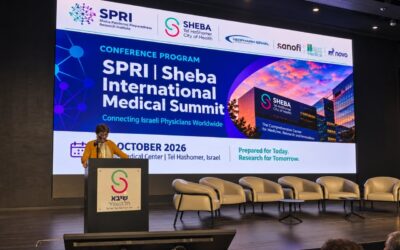
SPRI Summit 2026: Prepared for Today, Research for Tomorrow
Sheba Medical Center hosted the SPRI International Medical Summit on Sunday, October 25, 2026, connecting Israeli physicians worldwide through a program spanning pandemic preparedness, medical innovation and clinical research.

Sheba Medical Center Launches Free AI Chat for Cancer-Related Questions
The new 24/7 service offers patients and families access to cancer-related information based on a medically validated knowledge base, in multiple languages, as part of Sheba’s broader work in AI and digital health.

The Women’s Heart Center: A Tailored Model of Cardiac Care at Sheba
With Dr. Romana Herscovici at the helm, teams at Sheba’s Women’s Heart Center approach cardiac diagnosis, treatment, and follow-up with attention to how conditions present and progress in women.
